Ticks are making the news 
      & not in a good way!
Photo Courtesy of Calif. Dept of  Public Health
Deer ticks shown at different stages on a finger. 
L-R: Larvae, Nymph [aka seed ticks ]; Adult male; Adult female.
                                              
Courtesy

   American Lyme Disease Foundation


(click above titles for info)

The life cycle of a deer tick takes approximately 2 years to complete. Their development is dependent on both environment and availability of hosts. They may, however, be capable of developing in less than one year.

All three of the development stages require a blood meal from hosts. Deer ticks attach themselves to and feed on a single host during their larval stage, another during nymphal stage, 
and the third during adult stage.  
The tick larvae and nymphs both molt after feeding.

After laying eggs, the female adult deer ticks will die. 
One female is capable of laying up to 3,000 eggs. 

Six-legged larvae emerge from the eggs & begin search for a host. 
A larvae then feeds for about 4 days before dropping to the ground to molt and become a nymph. 
Nymphs have eight legs and once again search or hosts. They will the feed and molt into an adult.

Larvae
Larval and nymphal stage deer ticks prefer small hosts and are most likely to feed on rodents. Adult ticks are fond of white-tailed deer and sometimes feed on human hosts. Diseases are transferred to humans and animals during their nymphal and adult stages.

Eggs
Females lay eggs in suitable areas close to vegetation. Emerging as larvae, they immediately begin to search for hosts, which tend to be small, e.g.,  mice. During these early feeding stages is when ticks contract diseases such as Lyme. 
The diseases are transmitted to hosts during future feedings.


De-ticking clothes is best accomplished by throwing everything into a hot dryer for 15 minutes, even before washing. 
Washing clothes first does not kill them but drying does.

       On April 6, 1917, the United States formally entered World War I by declaring war on Germany. By the summer of 1917, communities around the country had mobilized human and financial resources in support of the Allied war effort. In light of this year marking the 100th anniversary of American forces joining the fight in WW1, this Memorial Day takes on a special significance.
www.memorialdayfoundation.org
The muffled drum's sad roll has beat
The soldier's last tattoo; 
No more on Life's parade shall meet 
That brave and fallen few. 
On Fame's eternal camping-ground 
Their silent tents are spread, 
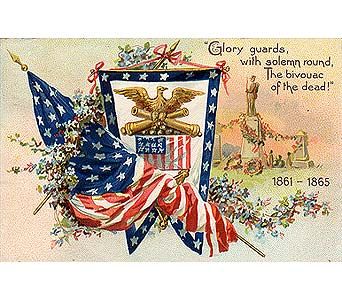
 And Glory guards, with solemn round,
 The bivouac of the dead.


Poem - Bivouac Of The Dead, 
by Theodore O'Hara


           Memorial Day, which is observed on the last Monday of May, commemorates the men and women who died while in the military service. 
It is a day dedicated for remembering and honoring military personnel who died in the service of their country, particularly those who died in battle or as a result of a wound sustained in battle.

            In observance of this day, many people visit cemeteries and memorials, and volunteers often place American flags on each grave site at national cemeteries. 


A National Moment of Remembrance takes place 
at 3:00 p.m. local time.
  Marking the Centennial of the United States
 entering World War 1

President Woodrow Wilson signed a
 War Resolution on April 6, 1917 to join Europe 
in the war that had begun in 1914 .

NJ has set this year aside to remember those who served.

Thomas Wainwright, born in Montague, was among those who served.
Courtesy of the NJ State Archives

125 years ago today-  Gladys Louise Smith was born.
                                 Academy of Motion Pictures Arts and Sciences                                                                                               / Academy Film Archive publicity still
She is best recalled as Mary Pickford, the star of silent films.
Filming in proximity to Montague, it's possible she may have visited here.

"The first silent movie ever made in the U.S. was filmed in Milford, Pike County in 1912. Mary Pickford, queen of the silent film era, starred in The Informer produced by D.W. Griffith.  The Informer was one of two films made in northeastern Pennsylvania in 1912, the other film, A Feud in the Kentucky Hills was shot in Pike County as well.  DW Griffith brought his troupe of 40 actors known as the Biograph players to Milford, Pennsylvania to utilize the local terrain.  The troupe stayed at the Sawkill House in Milford and used locations overlooking the Delaware River and used many local extras in the films, including Ernest Wood.
In 1927, the film industry visited Milford again to shoot The Strength of the Weak and used many locals as extras."
Courtesy - HISTORY at http://poconofilm.org